Buy & Build: capital buys. Leadership makes growth steerable.
Sort out who's responsible before you optimise the structure: the order almost everyone gets backwards. Why buy-and-build fails on leadership capacity, not on capital.

In short: Buy faster than you reclaim control and you don’t build a company. You build a portfolio that’s one only on paper. On the day of the closing, steerability drops, exactly when it’s needed most. The expensive mistake that follows is the order: optimising the structure before it’s clear who does what in it: responsibility first, then efficiency. And your acquisition pace isn’t capped by capital, but by the number of people who are allowed to decide.
Optimise first, integrate later: the order almost everyone gets backwards.
A managed security services provider grows by acquisition. Several firms taken over, more in the pipeline. The growth works, and with it grows something no one planned for: the back office. Marketing, purchasing, legal, IT, duplication everywhere.
So a push is decided: reclaim control within three months and streamline the admin. A sensible call. Only one question had never been answered beforehand: Who from which firm actually belongs where?
01 · Steerability drops on the day of the closing
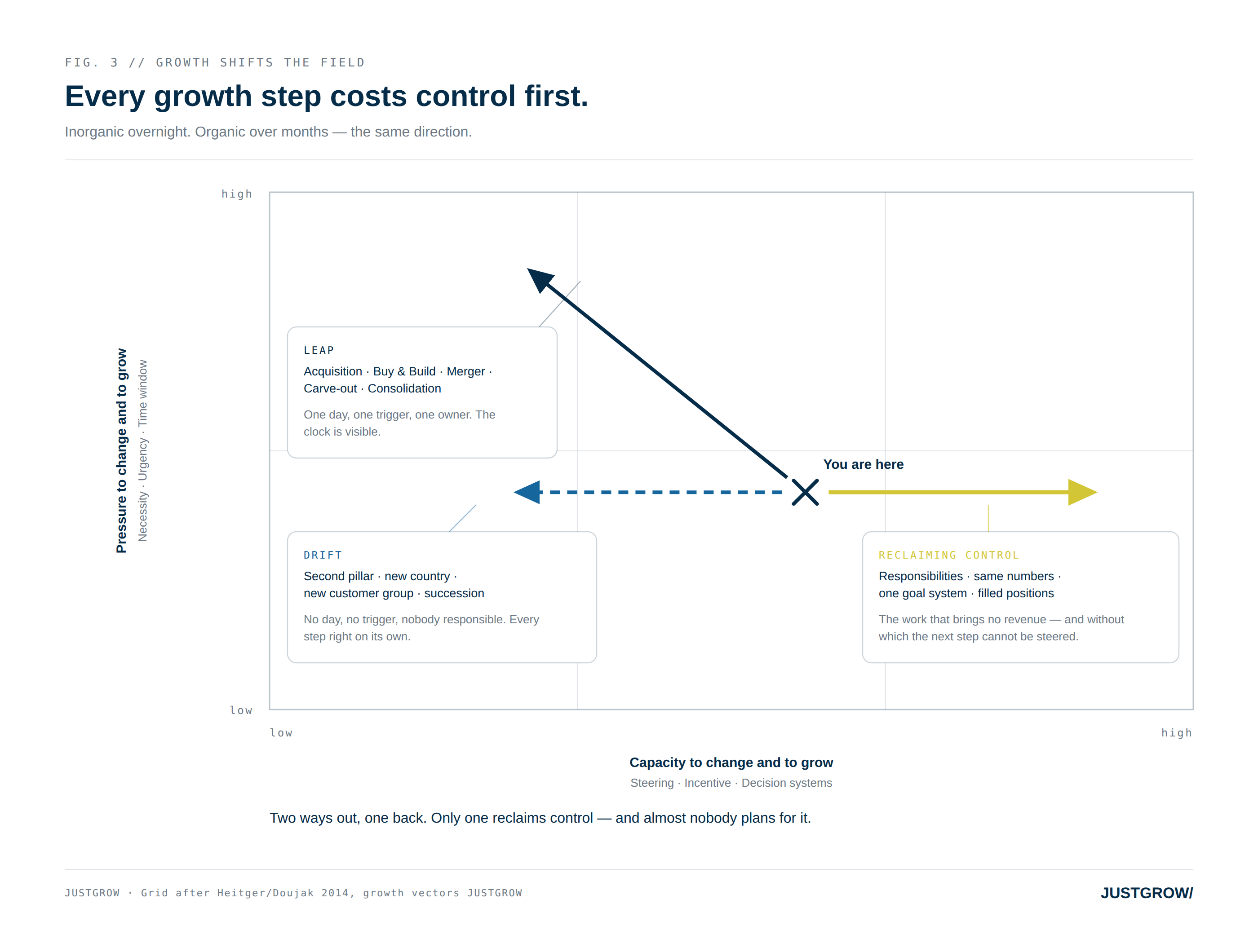
On the day of the closing, a company has two control systems, two sets of goals, two cultures and unresolved responsibilities. Steerability drops overnight, at the very moment it’s needed most. That’s not negligence but the price of growth: growth buys variety, and it’s paid for in steerability.
Steerability means decisions land reliably where they belong: clear responsibilities, shared numbers, one set of goals. An acquisition doubles the variety in a single day, and cuts steerability at a stroke.
Fig. 3: Every bout of growth costs steerability first.
The good part: the loss is dated. There’s a day, an occasion, someone accountable. That is why an acquisition gets organised at all. With organic growth the same thing slips away over eighteen months, and no one ever calls a halt. (That second case is covered in Part 1 of this edition.) So a closing has one advantage: it forces you to look. You just tend to look at the wrong thing.
And an acquisition isn’t the only jump. Merge two plants or two companies and you move on the same map in the same direction. That sounds backwards, since variety is actually being reduced. But consolidation means this: for the duration of the transition there are three states instead of two: the old, the other and the target. And with the people who leave, responsibilities disappear that no one ever wrote down.
02 · The order almost everyone gets backwards
Back to our managed security provider. The three-month push started, and it started with the back office. Marketing was scrutinised, then purchasing, legal, IT. Everywhere the sums were run on where functions could be merged. What those three months didn’t settle: which people from the acquired firms actually belong in the new structure, and which don’t.
Six months later, the first employees from the acquired firms stood at the door and asked the questions they’d been owed. What’s my role now? Who’s my boss? What stays, what changes? And because no one had answered them beforehand, each of them now answered for themselves. Some of them answered by leaving.
That’s the mistake, and it’s so common it barely registers: the structure gets optimised before it’s clear who does what in it. Efficiency before responsibility. It feels right, because efficiency can be worked out and responsibility can’t. And it’s still the wrong way round.
| Order | What happens | Result |
|---|---|---|
| Efficiency first (the mistake) | the structure is streamlined before roles are clear | smaller, but just as hard to steer |
| Responsibility first (right) | first settle who decides what, then optimise | steerability back, then efficiency |
The reason lies in what was actually lost on closing day. It wasn’t efficiency. It was steerability. Streamline an administration whose responsibilities are unsettled and you don’t make it more steerable. You make it smaller and just as unclear. The question “What’s my role now?” is therefore not an HR question. It’s the question of responsibility in its most personal form.
PMI (the time after the closing) isn’t an integration task. It’s about reclaiming control.
Concretely, four things:
- Clear responsibilities: who decides what without checking back.
- Shared numbers: both organisations work from the same definition of margin.
- One set of goals instead of two side by side.
- Filled key positions instead of interim cover.
None of these four is an IT project, and none is busywork. Three of them touch the CFO’s authority over the numbers and the founder’s habits. That’s exactly why they get left undone. (It’s the same four-part set as the organic drift in Part 1: the map holds for both routes.)
03 · When responsibility changes hands three times
In our case something else came in that explains it without excusing it. The COO was meant to run the effort. He was on holiday when it began, so the CEO took over. On his return he wanted to hand it straight back, but by then the COO was already on his way onto the supervisory board and passed it on in turn to an interim manager.
Three people accountable for the same task in a few months. None of them made a mistake, each handover had a sound reason. In sum, the effort still never had an owner who stayed long enough to ask the uncomfortable questions, and those questions are the heart of the task.
Whoever is to reclaim control therefore needs two things that are easy to overlook: continuity and decision authority. A stand-in has neither. They keep an effort ticking over. They can’t see it through.
And if it’s already happened? Then don’t start again from scratch. Gather the open decisions from all three phases in one place, put them in one pair of hands, and lock that pair of hands in for two quarters.
04 · The line item missing from the purchase price
Growth gets budgeted, the organisation behind it does not. The purchase-price model lists the transaction, the advisers, sometimes an integration budget for IT. What it doesn’t list is the one resource that’s genuinely scarce: the time of your leaders, the time of people who are allowed to decide.
So don’t count in percentages of the purchase price. Count in people and weeks. My rule of thumb for a mid-market acquisition: one key person, at least a quarter of their working time, over at least two quarters, with decision authority, not a coordination brief.
And now the part that makes the rule usable: don’t count it per deal, count it as a ceiling. Two key people with a quarter of their time each mean two open integrations. The third waits until one is closed. Three quarters of the same person isn’t capacity. That’s someone with no day job left.
Your acquisition pace isn’t capped by capital, but by the number of people who are allowed to decide.
05 · And when the person who really steers isn’t in the room?
In owner-led firms that’s the norm. The founder has stepped out of the management team, sits on the advisory or supervisory board, and still calls division heads directly. Formally, they no longer steer. In practice, they do. In our case it was the COO who moved onto the supervisory board and shaped the effort a while longer all the same.
For steerability that’s the most expensive of all the unsettled responsibilities, because it’s documented nowhere. And it explains why alignment meetings in such firms so regularly come to nothing: you align with the people in the room, while the influence comes from another room.
Whoever really steers, aligns.
From that follows the same rule as in Part 1: staff the room by influence, not by org chart. Anyone who regularly overturns decisions or calls division heads directly belongs at the table, even if they’re formally no longer operational. And if they refuse to mark their cross? That’s a result too. Then the question is no longer “where do we stand” but “who decides this here”, and that one matters more.
And yes, it costs: in a steerable company the founder decides less. Reclaim control and you take it from them first. That’s the real CEO/Founder Shift, and the reason this work is so reliably left undone.
The line to remember
Buy faster than you reclaim control and you’re not building a company. You’re building a portfolio that’s one only on paper.
Next step
Three questions before you go into the data room: do our existing units really work out “margin” the same way? How many key positions are currently filled on an interim basis? And: after the closing, who makes sure we stay able to steer: by name, not as a role, and with what share of their time?
If you can’t answer the third question, that’s not a no to the deal. It’s a statement about the timing. Postponing is cheaper. Buy without the leadership capacity and you pay twice: once for the purchase, once for the repair. If you’d like to work that capacity question through with someone from outside, that’s the heart of CEO sparring.
Part 1 of this edition covers the same mechanism for organic growth: The Nod Test: why growth fails before it begins.
The underlying map after Barbara Heitger / Alexander Doujak, Harte Schnitte, neues Wachstum, 2nd revised edition, Redline/Ueberreuter 2014. Axis labels and growth vectors: JUSTGROW. The case described is anonymised.
Frequently asked questions
What does PMI (post-merger integration) really mean?
PMI isn't an integration task; it's reclaiming control after the closing: clear responsibilities, shared numbers, one set of goals, filled key positions. Merge structures without settling who does what, and you make the admin smaller, not more steerable.
Why do buy-and-build strategies so often fail at integration?
Because the order gets reversed: the structure is optimised before it's clear who does what in it: efficiency before responsibility. On closing day it isn't efficiency that's lost but steerability; a streamlined but unsettled admin is just as unclear, only smaller.
How much leadership capacity does a mid-market acquisition need?
A rule of thumb: one key person, at least a quarter of their working time, over at least two quarters, with decision authority, not a coordination brief. Treat it as a ceiling: your acquisition pace isn't capped by capital, but by the number of people who are allowed to decide.
What's the most common mistake after buying a company?
Optimising the back office first, before it's clear which people from the acquired firms hold which role. The question "What's my role now?" goes unanswered, and some of the key people answer it by leaving.
Who should run a post-merger integration?
One person with continuity and decision authority, locked in for at least two quarters, not a stand-in. And whoever really steers belongs at the table, even if they formally sit on the advisory or supervisory board: whoever steers, aligns.