When growth stalls, it's rarely the product.
Four patterns from more than sixty leadership teams across the DACH Mittelstand, and the one-page plan that gets every leader on the same line in 60 seconds.

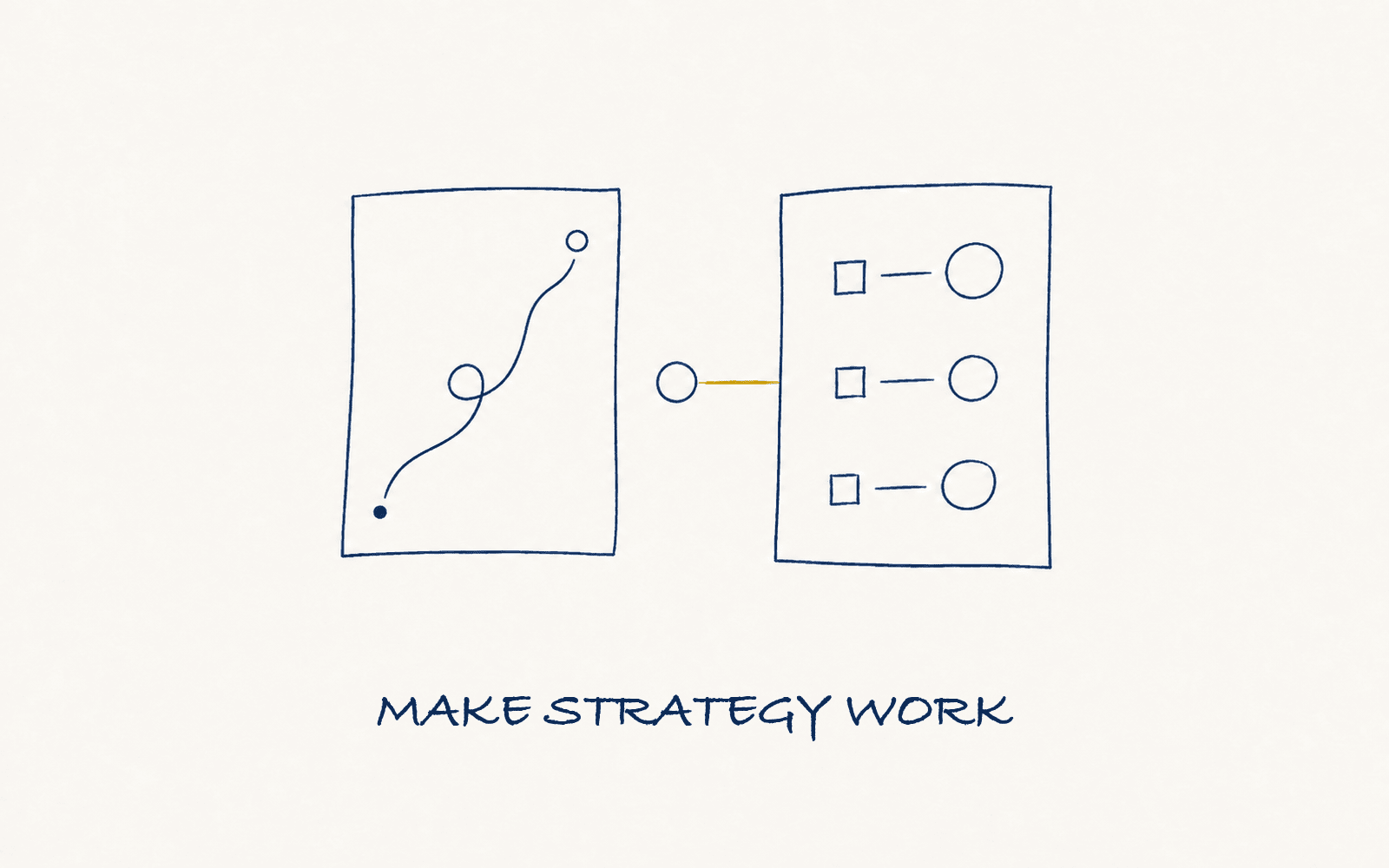
In short: Growth rarely fails on the product. It fails on translating strategy into everyday work. Four patterns keep coming back: hidden growth barriers, silos despite all the meetings, a strategy that lives only in PowerPoint, and priorities no one prioritises. What helps is not a new strategy but one page, three levers, an owner per lever and a rhythm that holds.
When a healthy company suddenly stops growing, the suspicion falls first on the market, the product, or the competition. In most cases, though, the problem is closer to home: in translating strategy into everyday work.
The diagnosis
Over the past five years we’ve worked with more than sixty leadership teams in scale-ups, Mittelstand companies, and hidden champions. In almost every case the same picture emerges: the strategy on the slide is convincing. The roadmap is well kept. The meetings are full. And still the company doesn’t pull through.
The discussion then almost always lands on the wrong symptoms: too little sales pipeline, too much technical debt, too weak a brand. These issues are real. But they’re rarely the cause.
That matches what Donald Sull, Rebecca Homkes and Charles Sull found across more than 250 companies in Why Strategy Execution Unravels: aligning up and down the line works in most houses. It breaks sideways, in the coordination between units.
“Growth rarely fails on the product. It fails on the translation.”
Four patterns that show up almost every time
When we structure the diagnosis, we find four patterns that recur in varying weight:
| Pattern | What the leadership team sees | What sits underneath |
|---|---|---|
| Hidden growth barriers | the company reacts more than it acts | the levers are neither named nor measurable |
| Silos despite all the meetings | good teams, full calendars, little pull | alignment eats the impact |
| Strategy only in PowerPoint | the slide convinces, everyday work never meets it | no one can explain it in 60 seconds |
| Priorities no one prioritises | everyone works, no one on the levers | things were distributed, never chosen |
1. Hidden growth barriers
The company reacts more than it acts. The symptoms are visible, the cause is not. Only once you name the levers and make them measurable does reaction turn into action.
2. Silos despite all the meetings
Good teams. Plenty of calls. And still everyone pulls in a different direction. Impact dissipates in alignment, and the only answer on offer is yet another meeting. Why more coordination fixes nothing here is in Silos despite all the meetings.
3. A strategy that lives only in PowerPoint
The strategy is articulated convincingly, but it doesn’t land in everyday work. No one in the extended leadership could explain it in 60 seconds.
4. Priorities no one actually prioritises
Everyone acts in good faith. Just not on the levers that truly count. Focus becomes an empty word, because no choice ever gets made.
The one-page plan
In nearly every engagement we work with the One Page Growth Plan. It’s not a new framework. It’s the translation of your existing strategy into a format your leadership team grasps in a single morning, and carries for a full quarter.
The plan has four fields:
- North Star. A statement anyone can explain in 30 seconds.
- Differentiating levers. Three, at most five, not twelve.
- Big-3 Priorities. Three things that count this quarter.
- Ownership. An owner per lever. A weekly rhythm.
Owners, not committees
The second lever is clear ownership. Every lever in the plan has a face. No steering group, no committee, no diffusion of responsibility. Who is accountable if this lever hasn’t caught in 90 days? Exactly one person, and everyone knows who that is.
When more than one person is responsible for a lever, no one is. Don’t distribute. Choose.
A rhythm that holds
The third and most underrated lever is rhythm. Weekly, monthly, quarterly. Three layers, three different questions, and no more special meetings.
- Weekly: Where is it blocked? 25 minutes, standing.
- Monthly: Where is it working? Which levers show movement?
- Quarterly: Are the priorities still right?
The takeaway
Growth rarely fails on the product. It fails on translating strategy into an everyday work life your team carries with it. One page. Three levers. Owners. A rhythm that holds. It isn’t spectacular, but it’s what sits between a plan and a movement. Almost no team makes that translation step alone. What it takes is sparring, not the next consulting study.
“One page. One plan. The whole team.”
Frequently asked questions
Why has our growth stalled when the strategy and the numbers are fine?
Because a translation step between strategy and everyday work is missing. The slide is convincing, the roadmap is kept, the meetings are full, and still the company does not pull through. The discussion then lands on sales pipeline, technical debt or brand. Those issues are real, but they are symptoms. The cause is that no one in the extended leadership can say what is actually being worked on this week and why.
Which patterns most often slow growth in mid-sized companies?
Four, in varying weight. Hidden growth barriers: the company reacts instead of acting, because the levers are neither named nor measurable. Silos despite all the meetings: alignment eats the impact. A strategy that lives only in PowerPoint. And priorities no one prioritises, because things were distributed rather than chosen. Left untangled, all four get the same remedy, usually another meeting.
Who should be accountable for a growth lever?
Exactly one person, by name, and everyone knows who. Steering groups and committees keep spreading accountability until no one carries it. The test question: who stands there if this lever has not caught in 90 days? If that cannot be answered with a name, the lever has no owner yet.
How often should a leadership team review its growth plan?
In three layers, each with its own question. Weekly, 25 minutes standing: where is it blocked? Monthly: which levers show movement? Quarterly: are the priorities still right? The value lies less in the frequency than in every question having a fixed place. Then the rest needs no special meetings.
How do I tell that our strategy is not landing in everyday work?
By whether someone from the extended leadership can say in 60 seconds what the company is betting on this year and what is no longer happening because of it. If the answer points at the slide, or comes out differently from every person, the strategy exists as a document and not as behaviour. That is not a communication problem, it is a format problem.