The best leadership development isn't a seminar.
Leadership development barely works in a seminar: only about 10% of it is formal learning. Why CEOs develop fastest among peers facing the same decisions.
In short: The best leadership development isn’t a seminar. Only about ten percent of what actually shapes a leader comes from formal training. The rest comes from real decisions and from exchange with people who carry the same responsibility. If you want to develop executives, you don’t put them in a course. You put them in a circle of peers facing the same stage.
Leadership development sounds like a catalogue: a two-day seminar, a model on a flip chart, a certificate. For many roles that works. For the managing director of a 120-person company deciding whether to open the second plant or first stabilise the first one, it doesn’t. Her problem appears in no standard curriculum.
Why the seminar is the weakest lever
Since the late 1980s, research from the Center for Creative Leadership has shown a stable pattern: leaders learn roughly 70 percent from the work itself, 20 percent from other people (exchange, feedback, observation) and only about 10 percent from formal training. The seminar isn’t worthless. It’s just the smallest of the three levers. Reduce development to the seminar and you’re optimising the weakest ingredient.
Leadership development is the process by which a leader builds the capabilities for the next stage of their company. Peer learning is the part of it that happens against the real decisions of other executives facing the same stage.
What actually develops leaders
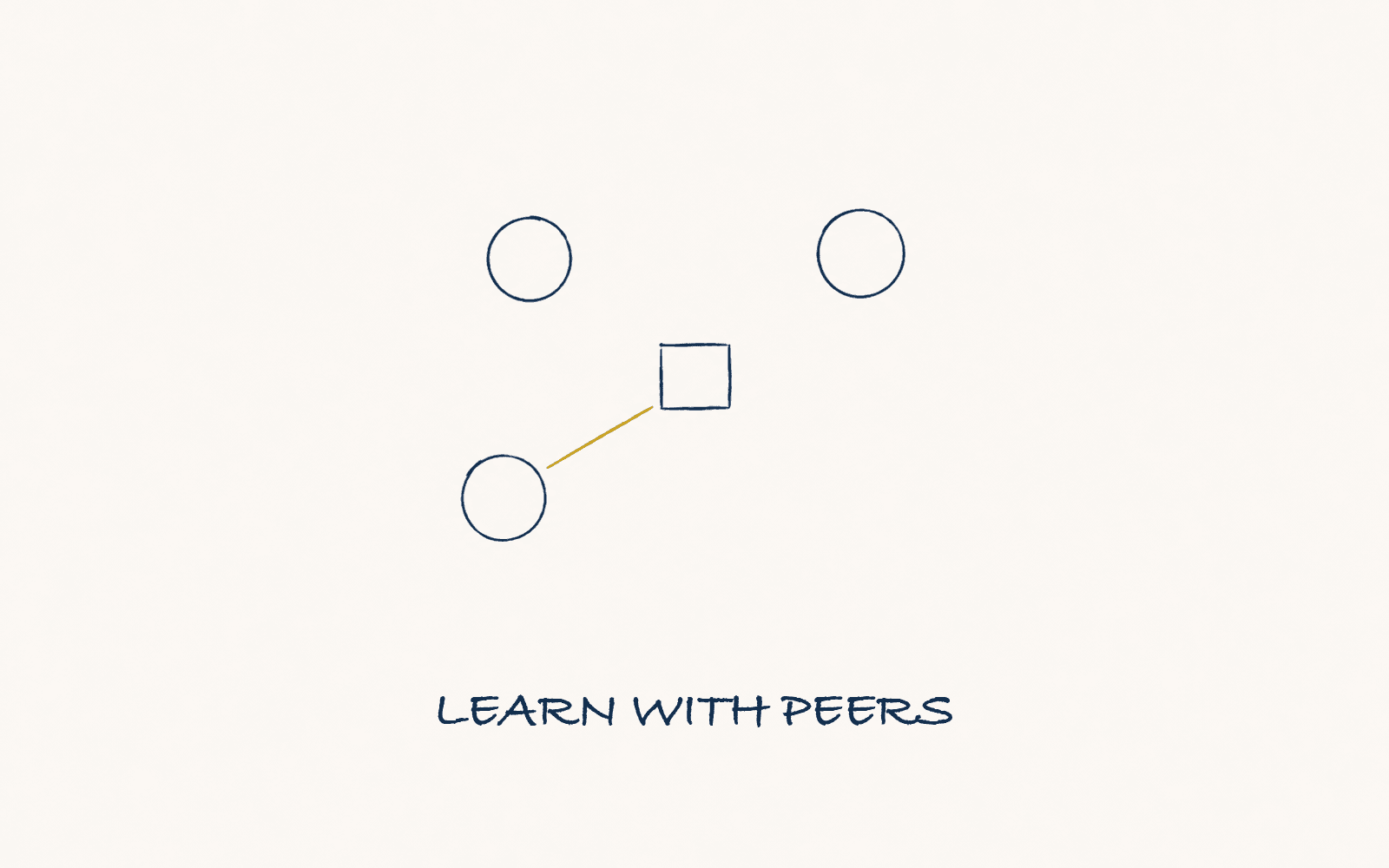
The underrated lever is the 20 percent: learning from others. Not from trainers, but from people who carry the same responsibility and put their decisions openly on the table. An executive just installing their first layer of leadership learns more in two hours with three others who have done it than in two days of seminar.
| Dimension | Seminar / classic leadership development | Growth Circle (peer learning) |
|---|---|---|
| Source of learning | trainer, standard curriculum | other managing directors with the same decisions |
| Share of learning (70-20-10) | ~10% (formal) | ~20% (from others), feeds the 70% (on the job) |
| Frame of reference | generic models | your own, concrete situation |
| Transfer | ends with the seminar day | leadership rhythm over months |
| Outcome | knowledge | decision |
An example from the sparring
Take a founder I worked with last year. Solid numbers, but every decision ran across her desk. No seminar on “delegation” had changed that; she knew the models by heart. What changed things was a circle of four other managing directors, two of whom had hit the same bottleneck two years earlier. They didn’t need theory. They put their own mistakes on the table. Three weeks later the founder had her first real decision charter, not because someone had taught her, but because she had seen how others had solved it.
The real thesis
My take: leadership development stands or falls on one question. Do you work on the individual, or do you put them in the right room? The common answer is more training, more coaching, more input. I’d argue the opposite. Experienced executives don’t lack input. They lack honest comparison with people who make the same decisions. That is exactly what a Growth Circle is: not a workshop, but a leadership rhythm over months.
And because insight from a circle like that evaporates in a full day, we don’t hold it on good intentions alone. That’s why, together with millionsteps, I build AI agents that carry the decisions into the weekly rhythm of leadership, so the peer conversation becomes behaviour, not a good resolution.
Where you stand today becomes clearer faster with the three guiding questions in Where You Stand; why maturity begins with the person at the top is in Mature Leadership.
The takeaway: Leadership doesn’t develop in a seminar. It develops among people who carry the same decision.
Next step: If you want to see what leadership development looks like as a leadership rhythm rather than a course, take a look at the Growth Circles.
Source: Center for Creative Leadership, “The 70-20-10 Rule for Leadership Development” (after Lombardo & Eichinger).
Frequently asked questions
What is the most effective form of leadership development?
Not the seminar. Under the 70-20-10 pattern, roughly 70% of development comes from the work itself and 20% from exchange with other leaders; formal training accounts for only about 10%. Executives develop fastest in exchange with peers facing the same decisions.
Why do leadership seminars often fail to stick?
Because they teach generic models that rarely fit the specific situation, and because transfer ends with the seminar day. Without repetition in the day-to-day, the input evaporates; it is the weakest of the three learning sources.
What is a Growth Circle?
A fixed circle of managing directors that works together over months in a leadership rhythm and learns from the real decisions of its members. A Growth Circle is a leadership rhythm, not a workshop.
Leadership development: coaching or peer learning?
Coaching works on the individual; peer learning puts the leader into a circle of equals who carry the same responsibility. For experienced executives who lack honest comparison rather than input, the peer circle usually works harder.
Who is peer learning among executives for?
For experienced CEOs and owners of mid-sized companies and scale-ups who face a new stage of growth and want to test their decisions against people who have already been through the same.